Are 3D printed cufflinks durable? How a titanium pair is made
3D printed titanium cufflinks are solid Grade 5 metal, fused by laser one layer at a time into one piece. How a pair is made and why the design rules exist.
Published , 5 min read
3D printed cufflinks can be anything from a plastic print to solid metal, and ours are solid metal: Grade 5 titanium, melted by a laser one thin layer at a time, with face and back printed as a single piece. That makes them durable, because there is no joint between face and post to work loose, and it lets them take shapes that casting and machining can't.
Below is how a pair is made from start to finish, why every design is checked against a set of rules before it can be ordered, and what printing makes possible.
How a pair is made, start to finish
- You design it. In the studio you pick a collection design or a blank face, then add text, monograms, motifs, patterns, borders and 3D elements such as a die, a stone or a dome. You choose the shape, the size and the back. You can also describe an idea in words, and the studio draws a one-of-one design for print.
- The studio checks it. A check step measures every line and gap against the titanium design rules. You can order once the design passes.
- It is printed. We use laser powder-bed fusion, also called DMLS. A laser melts fine titanium powder in layers typically 30 to 60 microns thick, finer than a human hair, fusing each layer to the one below. The whole cufflink, face and back, is built as one piece.
- It is finished. The cufflink is cut from the build plate, the supports that held it during the print are removed, and it is tumbled to a soft gray satin. A standard pair has no plating, enamel or paint.
- Signature pairs are coated. For a Signature pair, a specialist coater applies light gold or black titanium nitride over the tumbled titanium.
- It ships. Every pair is made to order and ships in about 6 weeks, with shipping included.
Are 3D printed titanium cufflinks durable?
Yes, for four reasons.
The metal. The laser melts the powder, so the finished cufflink is solid Ti-6Al-4V: about 90% titanium, 6% aluminum and 4% vanadium. The same alloy family is used for aircraft parts and medical implants.
One piece. Many cufflinks are assembled from parts: a face soldered to a post, a toggle pinned to its end. Each joint is a place where two parts meet. Ours are printed face and back as one piece, so the bar and fixed backs have no joints and no moving parts at all.
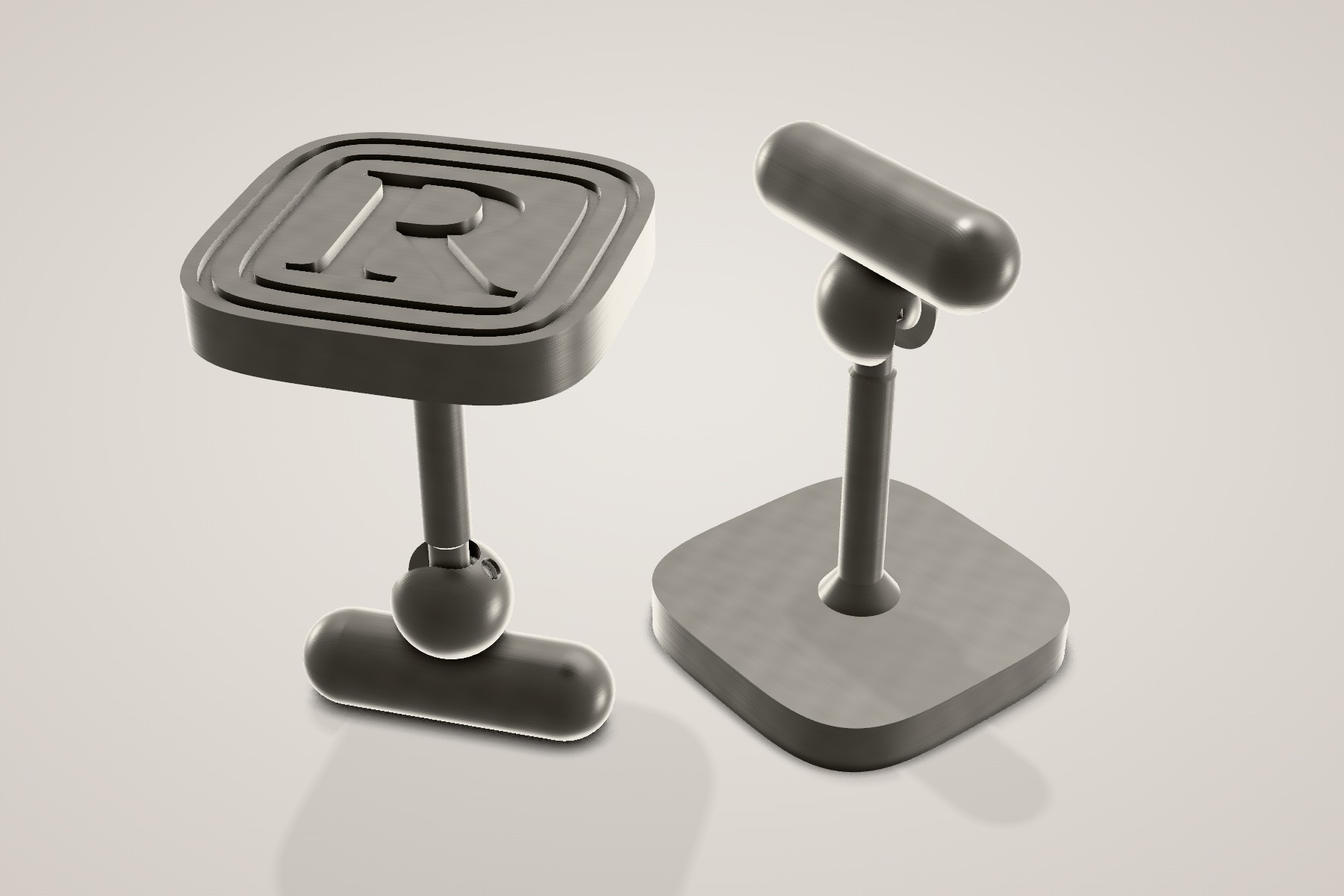
A printed joint. The bullet back has a single moving joint: a ball printed inside its socket with a clearance of 0.3 mm on each side, so it swivels straight from the printer. There is no separate pin to work loose. The three backs are compared in cufflink backs: bullet, bar and fixed.
Nothing on the surface. A standard pair has no plating, enamel or paint to chip. Titanium forms a thin, stable oxide layer, so it doesn't tarnish the way silver does and needs no polishing.
Why the design rules exist
Every design is checked against these minimums before it can be ordered:
| Feature | Minimum |
|---|---|
| Raised line width | 0.5 mm |
| Gap between raised lines | 0.4 mm |
| Engraved line width | 0.5 mm |
| Pierced hole | 0.8 mm |
Finer detail than that can't be held reliably in printed titanium. The laser and the powder each have a size of their own, so there is a limit to how fine a feature the process can build cleanly. Below it, a fine line may print broken, a narrow gap may close up, and a small hole may fill in. Tumbling then softens every edge slightly, so detail that only just survives the printer would not survive the finish.
The check exists so that the pair you approve is the pair that arrives. It is also why some ideas need a slightly larger face: a monogram with fine serifs may need more room to keep every stroke 0.5 mm wide.
What printing makes possible
Casting pours molten metal into a mold. Machining cuts a shape out of a solid block. Printing builds the shape up, layer by layer, and that opens up a few things the other methods can't do, or can't do economically.
A joint printed already assembled. The bullet back's ball is printed inside its socket. A one-piece joint like this can't be cast or machined in one piece.
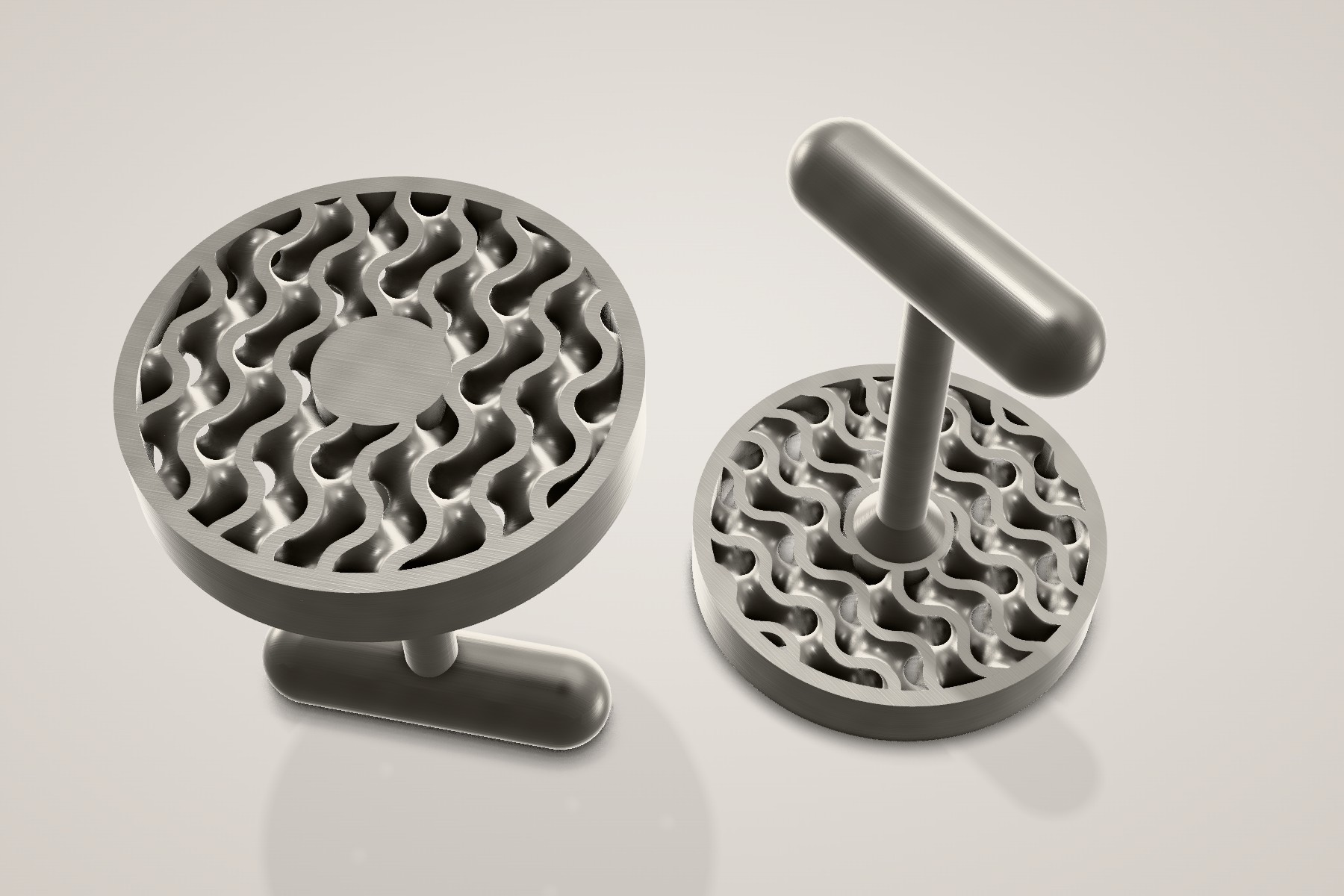
Lattices with depth. In a geometric lattice whose bars cross at different depths, a cutting tool can't reach behind the front bars to shape the ones beneath them. Printing builds the whole lattice at once, from the bottom layer up. Geometric lattices are one of our collection themes.
3D elements on the face. A die, a stone or a dome can stand proud of the face as part of the same piece of metal, rather than being made separately and fixed on.
One-offs without tooling. Casting needs a model and a mold for each design, and machining needs programming and tool time. Printing works from the design file. That is why our custom and generated designs cost only a little more than a collection pair, and why custom metal cufflinks don't have to be priced like a private commission. There is more on pricing in what custom cufflinks cost.
Questions
Are 3D printed titanium cufflinks durable?
Yes. They are solid Grade 5 titanium, printed face and back as one piece, with no joint between face and post.
Are they solid metal or plastic?
Solid metal. A laser melts titanium powder into solid Grade 5 titanium, one layer at a time.
Why can't my design have finer lines?
Below 0.5 mm for lines, 0.4 mm for gaps and 0.8 mm for holes, printed titanium can't hold detail reliably. The studio checks every design so that nothing is lost in printing.
How long does a printed pair take?
Every pair is made to order and ships in about 6 weeks, with shipping included.
Start from a collection design, a blank face or a few words describing your idea, and design your pair in the studio. The check step measures every line and gap against the titanium rules before you order, so what you design is what we print.